

Estate liquidity planning is often assumed to be complete once trusts are drafted and life insurance is in place. On paper, everything looks organized. But one critical question is rarely modeled: If a large estate tax bill arrives, where does the cash actually come from?
Estate Value and Estate Liquidity Are Not the Same Thing
A family may have substantial net worth while still lacking the liquid assets needed to pay estate taxes and settlement costs without selling real estate, business interests, or other long-term assets under pressure.
For affluent families with concentrated real estate, closely held businesses, or highly appreciated assets, net worth does not equal liquidity. Estate taxes are typically due within nine months, regardless of market conditions. Without proper estate liquidity planning, heirs may be forced to sell assets under pressure rather than by choice.
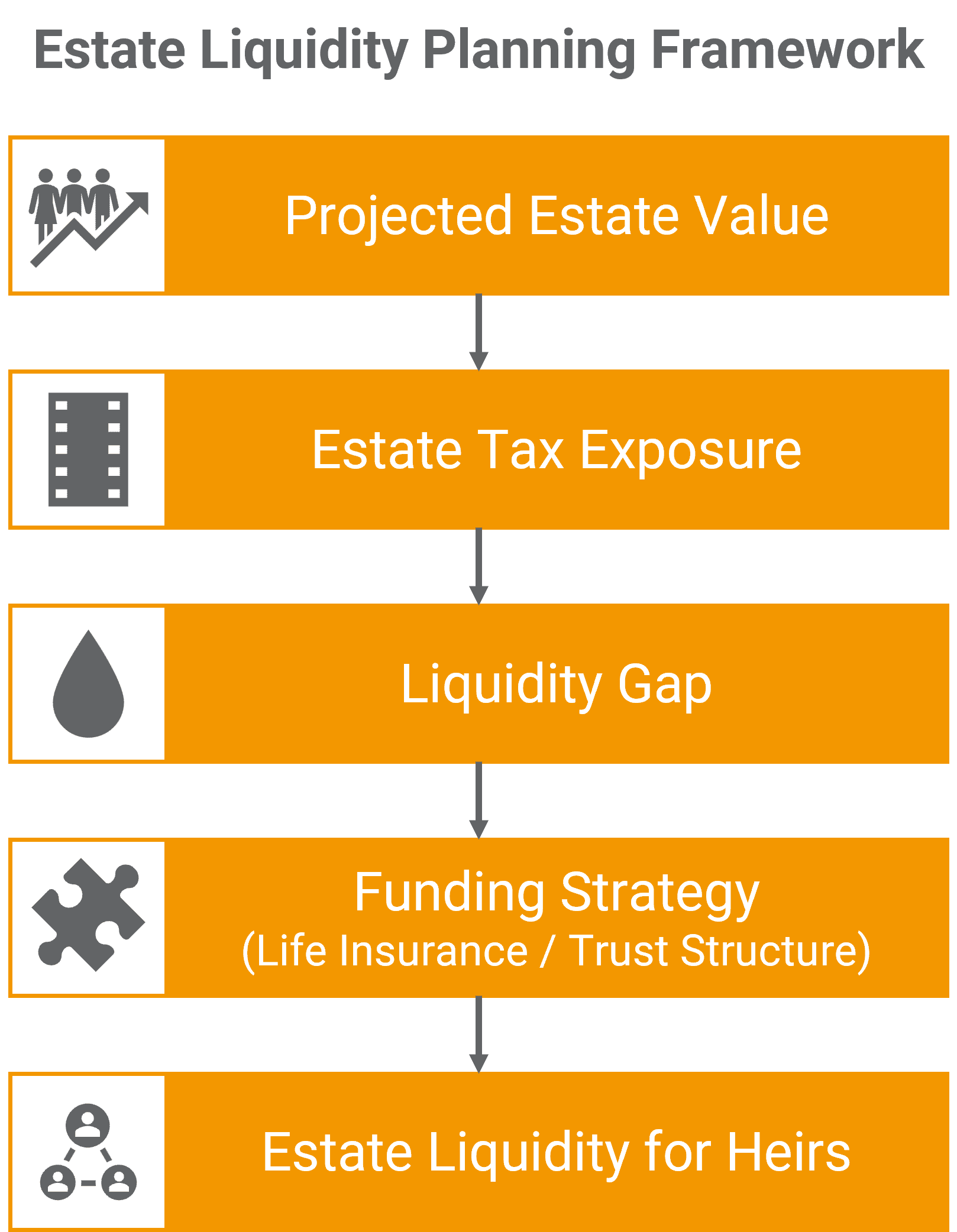
Owning a policy is not the same as engineering liquidity. Effective estate liquidity planning requires projecting future estate tax exposure, identifying the liquidity gap, and designing a funding strategy that can adapt as asset values, tax laws, and family circumstances change. The difference between guessing and engineering is clarity. And clarity protects a family’s legacy.
Liquidity Is a Math Problem Before It’s an Insurance Problem
When families think about estate liquidity, the conversation often begins with life insurance. In reality, insurance should not be the starting point. The starting point is clarity. Before any policy is designed, families need to understand what their estate may look like years from now. That means projecting the value of real estate, business interests, investment portfolios, and other appreciating assets—and then estimating potential estate tax exposure under current law while recognizing that both asset values and tax rules may change over time. Only after running these projections can the true liquidity gap be identified. A liquidity gap represents the difference between the estate tax that may be due and the liquid assets that would realistically be available to pay it, without forcing the sale of a business, a real estate portfolio, or a concentrated investment position. Many affluent families are surprised to discover that while their net worth is substantial, their accessible liquidity may be limited.
Projected Estate Value vs Liquidity Gap
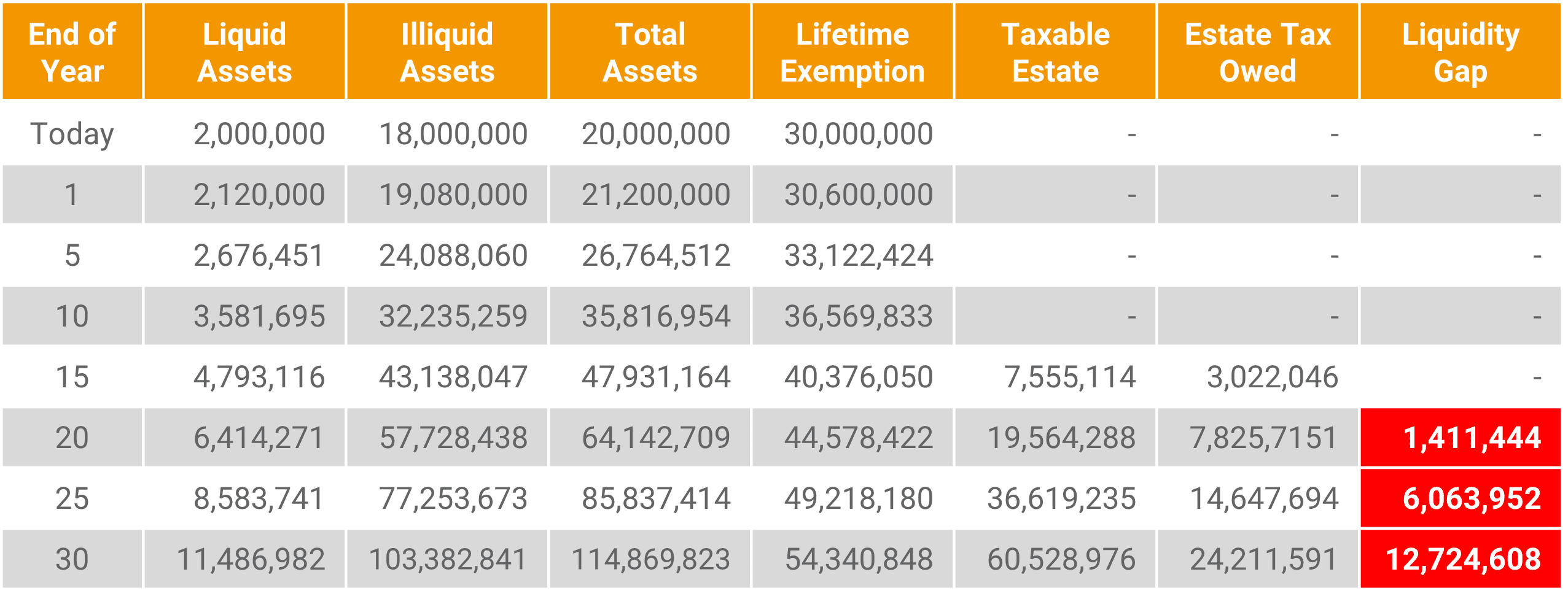
This example assumes a 6.00% annual growth rate on liquid and illiquid assets and a 2.00% growth rate of the lifetime exemption.
As estates grow over time, the gap between total asset value and available liquidity can widen significantly. Without planning, families may be forced to sell assets to satisfy estate tax obligations.
Timing complicates the equation further. Federal estate taxes are generally due within nine months. Markets do not pause. Buyers may not appear immediately. Financing options may not be ideal. Estate liquidity planning must account for when liquidity will be needed, not just how much. With the liquidity gap clearly defined, the next step is designing a structure capable of reliably closing the gap.
The Design Decisions That Determine Whether Liquidity Actually Works
Once projected estate tax exposure and liquidity needs are understood, thoughtful design becomes critical. Estate liquidity planning involves several coordinated decisions that must work together over time.
Ownership Structure
Coordinate who owns the policy and how that ownership fits within the broader estate plan. In many cases, families use an irrevocable life insurance trust (ILIT), while other ownership structures may be appropriate depending on the planning strategy.
Funding Strategy
Determine how premiums will be funded and whether the approach is sustainable over time. Funding may involve annual gifts, larger contributions, or structured financing depending on the family's circumstances.
Policy Design
Select a policy structure whose guarantees, flexibility, and performance characteristics support the estate liquidity objective rather than evaluating the insurance independently of the plan.
Ongoing Oversight
Review policy performance, estate projections, and planning assumptions as circumstances change. Estate liquidity planning should be managed as an ongoing strategy rather than a one-time transaction.
When these decisions are made deliberately and coordinated with the broader estate plan, estate liquidity becomes engineered rather than assumed.
Where Estate Liquidity Plans Quietly Break Down
Most estate liquidity strategies do not fail suddenly. They drift. The policy is issued, premiums are paid, and statements are filed away. Over time, however, estates grow, markets change, and assumptions embedded in the original design begin to shift. One common issue is underfunding. Policies designed under certain crediting assumptions may require more disciplined funding than originally anticipated. When contributions fall short of projections, the long-term durability of the coverage can weaken. Another issue arises when estate projections become outdated.
Appreciating real estate, business growth, or concentrated investment positions can expand the estate faster than originally modeled. When that happens, the liquidity gap may widen beyond the amount originally insured. Administrative oversight can also become an issue. If an irrevocable trust owns the policy, trustees must follow proper procedures, including required Crummey notices and documentation.
Over time, these responsibilities may be overlooked if the strategy is not periodically reviewed. Without ongoing oversight, families may assume their liquidity plan is functioning exactly as intended when, in reality, the strategy may not have been revisited and a life insurance policy review may not have been completed for several years. Estate liquidity planning should not be viewed as a one-time transaction. It is a long-term strategy that benefits from periodic modeling and review.
Engineering vs. Buying: Why the Distinction Matters
For many families, estate liquidity planning begins with a product conversation. A policy is recommended, coverage is placed, and the issue is considered solved. But effective estate liquidity planning rarely works that way. Engineering estate liquidity begins with understanding the estate itself — its projected growth, its asset composition, and the potential tax exposure that may arise in the future. From there, the liquidity gap can be measured, ownership structures coordinated, and funding strategies designed to remain intact over time. In that context, life insurance becomes an implementation tool rather than the starting point. When structured thoughtfully, insurance can provide predictable liquidity exactly when it is needed, allowing families to preserve businesses, retain long-held real estate, and maintain control over how assets transition to the next generation. Estate liquidity planning is ultimately about protecting options. It allows families to determine how assets are transferred, rather than allowing tax deadlines to dictate those outcomes.
How Do Affluent Families Pay Estate Taxes Without Selling Assets?
One of the most common concerns families have is how estate taxes will actually be paid when they come due. Because federal estate taxes are generally due within nine months, families may not have the flexibility to wait for favorable market conditions or a strategic asset sale. Without proper estate liquidity planning, heirs may be forced to sell real estate, business interests, or investment assets simply to generate the cash required to satisfy the tax obligation. Affluent families often address this challenge by planning liquidity in advance. Strategies may include maintaining liquid reserves, structuring trusts to hold liquid assets outside the taxable estate, or using properly designed life insurance to create liquidity precisely when it is needed. When liquidity is planned intentionally, estate taxes can be paid without forcing the next generation to make rushed decisions about long-held family assets.