

The federal lifetime gift and estate tax exemption has been one of the most discussed planning topics of the past several years. For affluent families, it has shaped decisions around large gifts, irrevocable trusts, and liquidity strategy.
Much of the urgency stemmed from the scheduled sunset of the Tax Cuts and Jobs Act (TCJA), which was expected to reduce the exemption after 2025. That concern drove meaningful planning activity across 2024 and 2025.
As of January 1, 2026, the law provides greater clarity. Understanding where the lifetime gift tax exemption stands today — and how it fits into long-term estate design — remains important for families with significant and growing wealth.
The 2026 Federal Basic Exclusion Amount Is $15 Million Per Individual
The higher exemption changed the immediate planning environment, but it did not eliminate the need to evaluate asset growth, estate liquidity, trust design, and long-term transfer objectives.
What Is the Lifetime Gift Tax Exemption?
The federal estate and gift tax systems are unified. An individual's basic exclusion amount can generally be applied against taxable transfers during life or at death, and taxable lifetime gifts can reduce the exclusion remaining at death. Transfers exceeding the available exclusion may be subject to federal gift or estate tax, with a top federal transfer-tax rate of 40%.
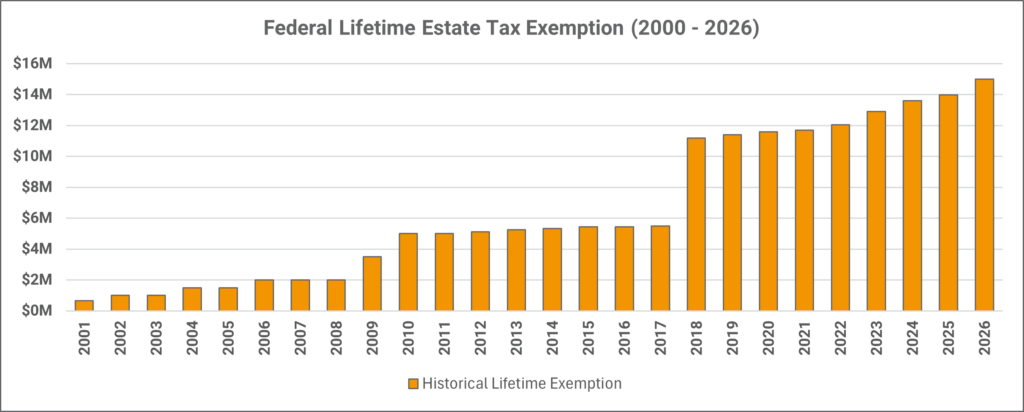
Federal estate and gift tax exemption amounts have changed significantly over time. Legislative changes have repeatedly altered planning thresholds.
For 2026, the federal basic exclusion amount is $15 million per individual. Portability may allow a surviving spouse to use a deceased spouse's unused exclusion if the applicable requirements are satisfied, potentially increasing the amount available to a married couple.
Separate from the lifetime exclusion, the federal annual gift-tax exclusion remains $19,000 per recipient in 2026. The annual exclusion generally applies to qualifying present-interest gifts. Gifts of future interests — including certain transfers involving trusts — should not be assumed to qualify simply because the amount transferred is below $19,000.
Married couples may also elect to split qualifying gifts for federal gift-tax purposes, subject to applicable requirements and reporting rules.
While the current exclusion is historically high, effective planning should not focus solely on the number.
Where the Lifetime Exemption Stands After 2025
Under prior law, the temporary increase enacted by the TCJA was scheduled to expire at the end of 2025. That scheduled change was expected to reduce the basic exclusion amount significantly beginning in 2026.
Because of that statutory schedule, many families accelerated planning — particularly larger lifetime transfers to irrevocable trusts — before the anticipated reduction.
Legislation enacted in 2025 changed that outcome. Beginning in 2026, the federal basic exclusion amount is $15 million per individual rather than reverting to the substantially lower amount contemplated under prior law.
As a result, the immediate “use it before it drops” pressure that shaped much of the 2024 and 2025 planning environment has eased. But the broader planning questions remain.
The exemption amount is only one variable in estate design. Asset growth, liquidity risk, family objectives, ownership structures, and flexibility can matter just as much over time.
The No-Clawback Rule and Prior Lifetime Gifts
A key technical concern during the sunset discussion was whether a person who made substantial gifts while the basic exclusion amount was higher could later lose that tax benefit if the exclusion subsequently declined.
Treasury regulations established a special rule designed to prevent that result. In general, the estate-tax calculation can preserve the benefit of a higher basic exclusion amount previously used for qualifying lifetime gifts rather than effectively subjecting those transfers to estate tax solely because the exclusion later declined.
The rule provides important protection for prior exemption planning, but it should not be interpreted to mean that every trust or transfer strategy implemented under prior law remains appropriate indefinitely.
Trust terms, asset performance, family circumstances, liquidity needs, tax law, and other planning assumptions can change. Existing strategies should therefore continue to be reviewed on their own merits.
Why the Lifetime Gift Tax Exemption Still Matters in 2026
The higher 2026 exclusion changed the immediate tax environment, but three strategic considerations continue to make lifetime transfer planning relevant for affluent families.
Legislative Change
Federal estate and gift tax rules are established by law and can change again. A durable estate plan should retain flexibility rather than depend entirely on today's exemption amount.
Asset Growth
Business interests, private investments, real estate, and other appreciating assets can grow faster than the exclusion amount, creating future estate exposure even when today's estate appears to fall below the threshold.
Estate Liquidity
The size of a potential estate-tax liability is only part of the analysis. Families must also consider where the cash would come from when obligations arise, particularly when wealth is concentrated in illiquid assets.
Asset Growth Can Matter as Much as Today's Exemption
For families with concentrated business interests, private investments, real estate portfolios, or other appreciating assets, the estate's future growth may matter more than its current value.
A $20 million estate today could become substantially larger over the next decade. Depending on the assets involved and the family's objectives, lifetime transfers may remove not only the transferred property from the taxable estate but also some or all of its subsequent appreciation.
That means the strategic question is often broader than simply whether to “use” the exemption. Families may also need to consider which assets have the greatest potential for future appreciation, how much control or access they are willing to relinquish, and how a transfer fits within the broader estate plan.
Estate Liquidity Can Drive the Planning Decision
Even when projected estate-tax exposure appears manageable, liquidity can create a separate planning challenge.
Federal estate taxes are generally due within nine months after death. Families whose estates are heavily concentrated in businesses, real estate, or other illiquid assets may therefore face a mismatch between the value of the estate and the cash readily available to satisfy estate obligations.
Lifetime gifting and trust planning can intersect directly with this issue. Depending on the circumstances, irrevocable trusts and properly structured life insurance may form part of a broader strategy designed to provide liquidity without requiring heirs to sell long-term assets under pressure.
For a deeper look at this issue, see our discussion of estate liquidity planning.
How Affluent Families Structure Lifetime Exemption Planning
The lifetime gift tax exemption is not necessarily implemented through simple outright transfers. Depending on the family's objectives, lifetime transfers may instead be coordinated through trust and ownership structures designed around control, access, asset protection, tax considerations, and multigenerational planning.
Potential strategies may include irrevocable trusts for descendants, Spousal Lifetime Access Trusts (SLATs), generation-skipping planning, and Irrevocable Life Insurance Trusts (ILITs).
When life insurance is incorporated, design discipline becomes particularly important. Ownership structure, premium funding, policy selection, guarantees, projected performance, and ongoing monitoring can all affect whether the insurance continues to support the underlying estate-planning objective.
The appropriate structure depends on the family's circumstances and should be coordinated with the family's estate planning attorney, tax advisors, and other professionals.
Planning Beyond the Exemption Amount
Estate planning in 2026 is less about reacting to a single exemption threshold and more about understanding how today's decisions may perform as assets, laws, and family circumstances evolve.
Four questions can help frame that analysis:
How Could the Estate Grow?
Model how business interests, real estate, investments, and other assets could affect potential estate exposure over the next 10 to 20 years.
Where Will Liquidity Come From?
Identify the assets or funding sources that could satisfy estate obligations without requiring an unwanted or poorly timed sale of long-term holdings.
How Much Flexibility Is Needed?
Consider how trust structures and transfer strategies may affect access, control, future planning options, and the family's ability to respond to changing circumstances.
What Role Should Life Insurance Play?
Determine whether life insurance supports a defined liquidity or wealth-transfer objective and how ownership, funding, and policy design should coordinate with the broader plan.
Families with significant or rapidly appreciating estates, particularly those with illiquid or concentrated holdings, may benefit from modeling multiple scenarios before implementing major transfers.
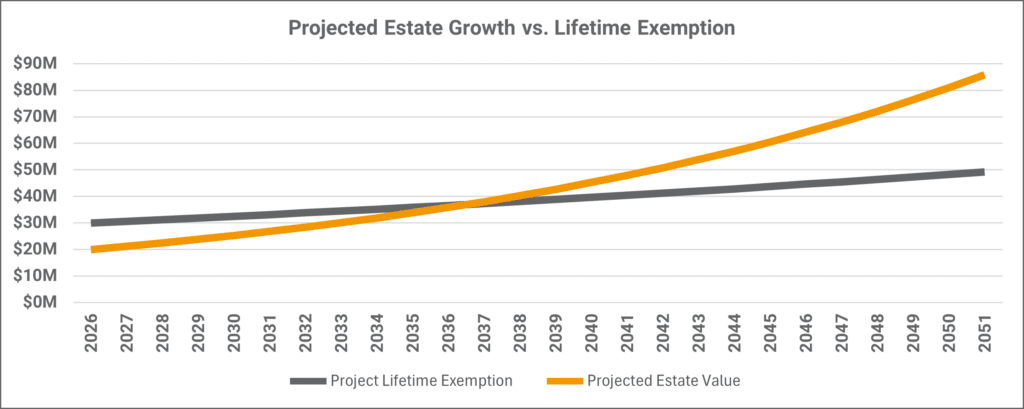
This illustration assumes a $20 million estate growing at 5 percent annually and compares that growth with a hypothetical $30 million combined exemption for a married couple growing at 2 percent annually. Actual exemption amounts, asset growth, tax exposure, and planning results will vary. For illustrative and discussion purposes only.
The objective is not simply to minimize tax. It is to create an estate plan capable of adapting across market cycles, legislative changes, and generational transitions.
The Lifetime Gift Tax Exemption as Part of a Larger Strategy
The 2026 lifetime gift tax exemption provides greater clarity than families faced during the years leading up to the anticipated TCJA sunset. But a higher exemption does not eliminate the need for disciplined planning.
Asset values can change. Family circumstances evolve. Liquidity needs may emerge. Tax laws can change again.
When appropriate for the family's objectives, lifetime gifting may help transfer future appreciation, coordinate multigenerational ownership, and reduce future estate exposure. Trust structures and life insurance may also play a role in addressing liquidity and wealth-transfer objectives.
The key is coordination. The exemption should be evaluated as one component of the broader estate strategy rather than treated as a reason to make transfers on its own.